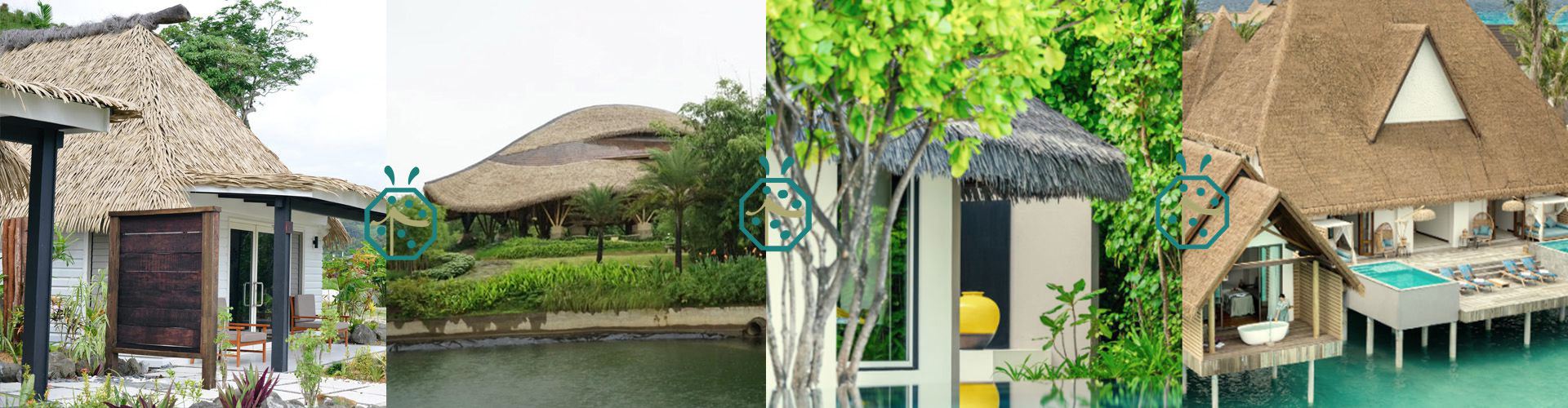
Various styles of synthetic thatch roofs help you create perfect escapes for a staycation in luxury resort hotel, tourism beachfront park, private garden landscape, swimming pool side, etc. But even though synthetic thatch tile seems a simple product compare with many other industries, but in the market, there are still lots of quality issues, such as color fading, easy decay, not fire retardant, etc. Producing high-quality synthetic thatch is a complex engineering feat that requires balancing aesthetic realism with rigorous structural and safety performance. Manufacturers face several critical challenges in creating a product that not only mimics nature but outperforms it in durability and fire retardant performance.
Choosing high-quality synthetic thatch roof is a critical investment for a resort villa, impacting both the guest experience (aesthetics) and operational costs (maintenance). Because synthetic thatch is designed to replicate natural materials while offering superior durability, you should evaluate products based on the following key technical and aesthetic criteria:
For resort hotels, the corporate philosophy behind synthetic thatch production is not a secondary concern—it is the cornerstone of long-term performance and return on investment. A company attitude is correct or not is the most important factor decides if we could produce the high quality synthetic thatch roof. Companies that prioritize cost-cutting by using non-virgin recycled materials and omitting essential compound UV-retardant and antioxidant additives are choosing a path that leads directly to premature roof degradation, discoloration, and brittleness. In contrast, a philosophy anchored in quality commits to using scientifically stabilized, high-grade polymers and rigorous additives to ensure the synthetic thatch resists relentless sun and weather. This commitment protects the hotel's aesthetic appeal, guest safety, and ultimately, its brand reputation and financial investment by delivering a roof that endures for years without decay.
2. Material Composition for Thatch Tile Production
The raw material used for synthetic thatch production is also one of the most significant factors for ensure high quality besides the company philosophy mentioned in the above.
In the market, the common materials used for thatch production include PP, PVC, HDPE and Nylon.
PP thatch roof normally uses copolypropylene (Co-PP) resin or high-crystallinity polypropylene (HC-PP) resin as raw materials. PP thatch roof has more straight looking and great for the texture. But disadvantage for PP thatch roof is easier decay in outdoor environment.
PVC thatch roof's advantage is it will not burn and spread fires, has great fire retardant performance for resort hotel facilities. The disadvantages include:
1. It will release toxic gases when exposed to fire.
2. In tropical countries, under hot weather, they will become soft and make the project looking not good enough. In this industry, Viro thatch's PVC thatch roof product is better, but their product will become soft more or less still.
3. PVC thatch is difficult to make complicated texture and colors. It is only available for few colors and the appearance is comparatively dull.
4. PVC thatch roof has color fading issue much easier than other materials.
HDPE materials are the best materials for making high quality synthetic thatch tiles until now. Advantages include:
1. It is non-toxic, does not off-gas harmful chemicals.
2. HDPE thatch remains flexible in extreme temperatures (preventing cracking in winter or melting in extreme heat).
3. It will not become soft in hot weather.
4. It do not have color fading issue.
5. It is easier to make complicated colors or textures, easier to customize the apperance as per clients' project request.
6. Ensure the HDPE material has UV stabilizers embedded throughout the product, not just sprayed on the surface. This prevents fading and brittleness over time and has great UV-retardant performance.
Compared with PP or PVC materials, nylon materials are better. But nylon could not be made for complicated colors or textures like HDPE materials. And nylon thatch also have some fading issues (Not as serious as PVC materials however. With the time going, nylon thatch will become darker and older.). Nylon thatch has fluffier looking compared with HDPE. At the same time, nylon thatch is not suitable for projects in dry regions. In dry regions, nylon thatch will break much easier than other materials.
3. Safety and Fire Ratings of Artificial Thatch
Fire-rated thatch is critically important for resort hotels to protect guests, prevent rapid fire spread inherent to traditional thatched roofs, and meet strict building regulations. Using approved materials and barriers can significantly reduce fire risks, helping to safeguard valuable property and preserve its heritage aesthetic. Synthetic thatch products are plastic, they are unable to reach all class A fire rating indexes, even though some companies say their products could reach. However, high-quality synthetic thatch often comes with fire-retardant properties included in the manufacturing process to reach most of the class A fire rating indexes. As the disadvantage of PVC thatch, we do not discuss PVC thatch here. For HDPE and nylon thatch, with proper formula, under the fireproof test standard of UL94-2013, both high quality HDPE thatch and nylon thatch could pass 6 indexes among all the 7 indexes.
4. Durability and Weather Resistance
Resorts are often located in coastal or tropical areas subject to harsh weather, such as Maldives, Philippines, Fiji, Costa Rica, Panama, Malaysia, Singapore, Seychelles, etc. In these places, there are many world-class resort hotels, so there is a high demand for high-quality anti-aging synthetic thatch roof tiles. We need to consider below aspects when deciding for procurement of thatch tiles:
Check if the product has greast he binding strip or installation method should be robust enough to prevent uplift. It requires the thatch roof to be strong when facing strong winds and also need to have strong installation system.
While the thatch itself sheds water, for a villa, you must ensure the sub-roof system (waterproof membrane) recommended by the manufacturer is high quality. The thatch acts as a decorative shield; the sub-roof keeps the villa dry.
Premium synthetic thatch typically lasts more than 20 years, whereas natural thatch may need replacing every 3-5 years. At the same time, poor quality synthetic thatch tiles may last shorter than natural thatch roof materials. Poor quality faux thatch sometimes may even decay in half a year!!
5. Aesthetic Authenticity
The "luxury" feel of a resort villa depends on the roof looking real.
Avoid products that look like uniform plastic injection molds. High-quality leaves have varied textures and slightly different widths to mimic natural palm or reed.
Look for products that mix different shades (tans, browns, yellows, and slight greens) to replicate the natural aging process of dried leaves. Monochromatic thatch looks artificial.
6. Warranty and Maintenance
High quality synthetic thatch could last at least 15-20 years. A credible synthetic thatch manufacturer will offer a warranty ranging from 10 years to limited lifetime.
The primary advantage for high quality synthetic thatch is nearly zero maintenance during its whole lifespan. If a product requires periodic sealing or chemical sprays, it defeats the purpose of choosing synthetic.
By focusing on Class A fire-rated (for most indexes) HDPE thatch products with a 10-year+ warranty, you ensure your resort villas maintain their tropical charm without the liability and maintenance headaches of natural thatch.
Welcome your inquiry to us
Tel: +8613400623179
Whatsapp: +8613400623179
Email : jack.lim@beatlesbm.com
Group 2, Zhaishang Village, Huli District, Xiamen, China
Get A Free Quote


Scan to Whatsapp:



 IPv6 network supported